The mark
Built to hold.
Three strands, one centre, and a clearance that is never painted. Four cuts of the mark and four diagrams, all generated from one parameter set, each tied to something the platform actually enforces.
01
Origin
The knot is older than the wheel.
Rope, net, sail, bridge. Every civilisation arrived at it independently, because it answers a question every maker eventually asks: how do you hold two things together without breaking either one. A knot holds by geometry, not by glue. That is the standard we set for everything we build.
EvidenceThree strands, three crossings, one continuous construction. The drawing is generated, never traced: every coordinate is computed.
02
Structure
A knot cannot be untied. It can only be verified.
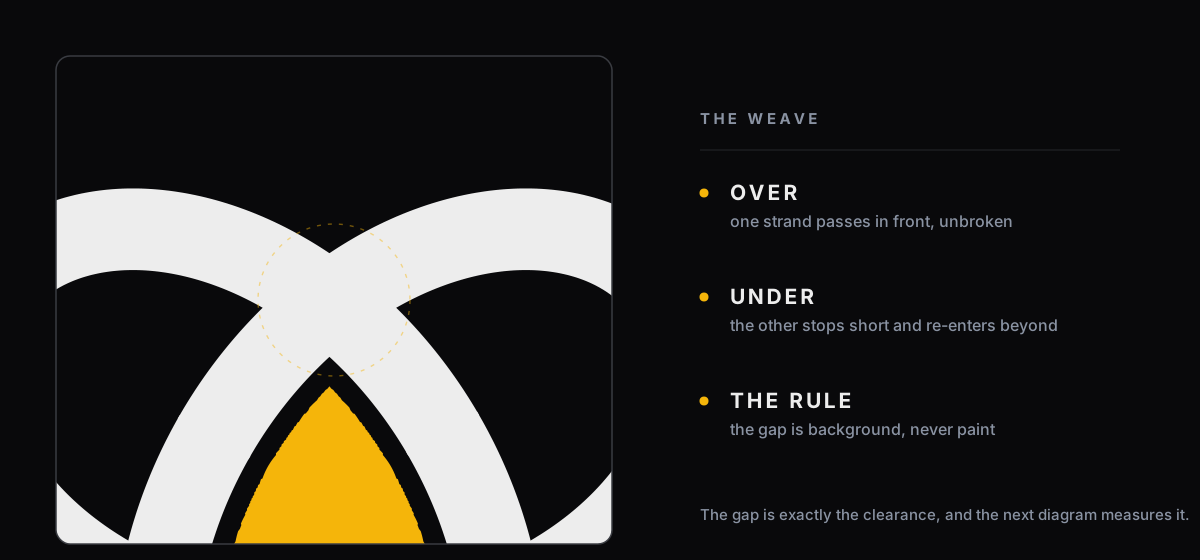
There is no trick that opens a true knot from the outside. You either follow the whole path, or you cut it. Unforgeability is the same property a signature needs, which is why the mark is one woven line: at every crossing one strand passes over another, and nothing passes through anything else without that layer having a say.
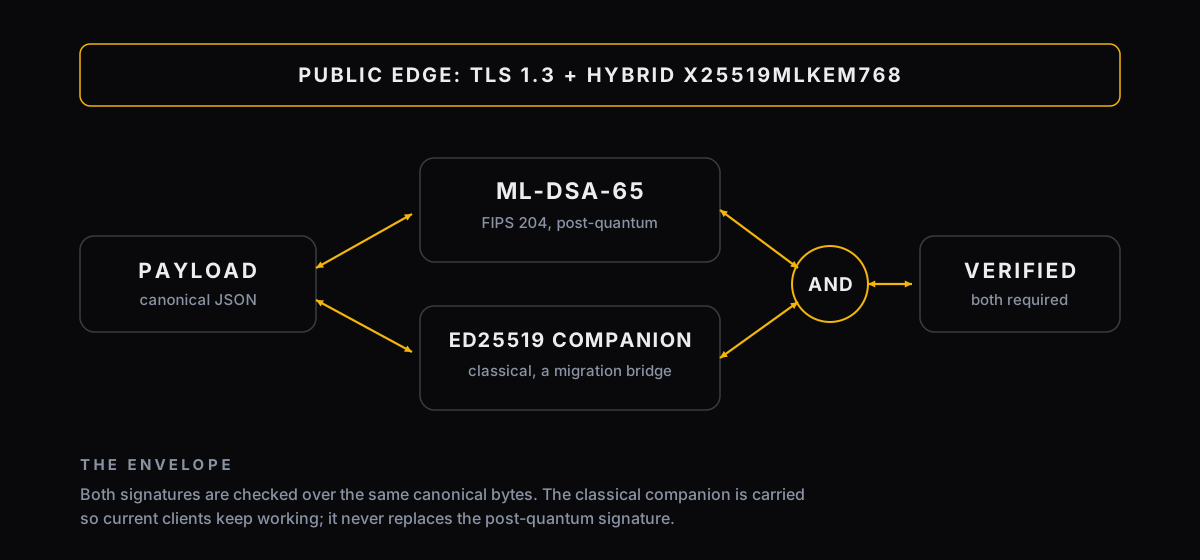
EvidenceEvery Bee-issued credential is a canonical JSON payload signed with ML-DSA-65 (FIPS 204) plus an Ed25519 companion signature, and both signatures must verify. Classic cryptography is a migration bridge, never a substitute.
03
Quantum
Entanglement left the laboratory.
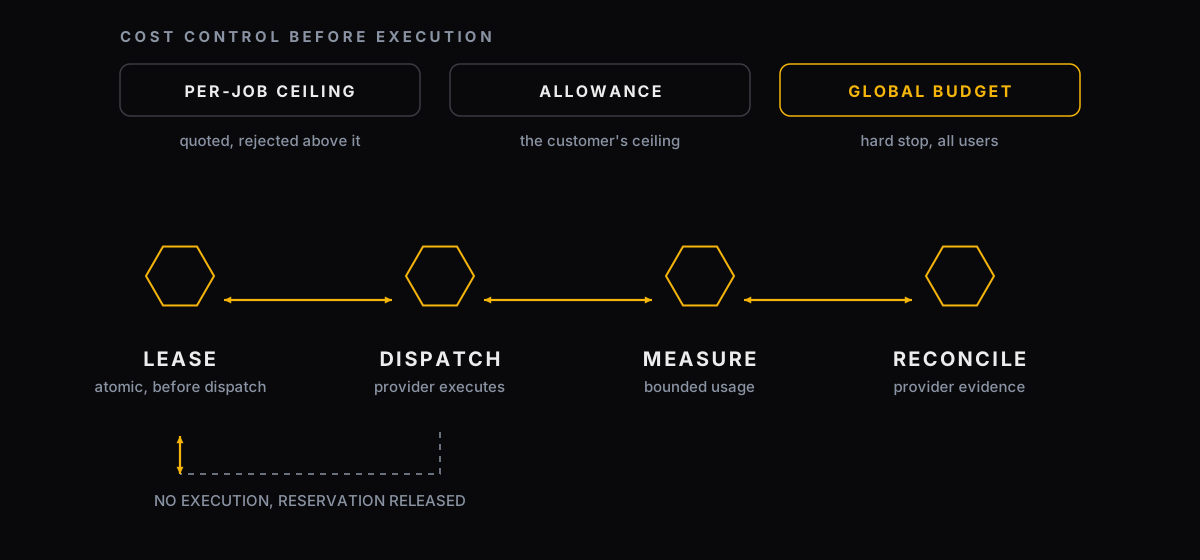
Quantum hardware runs real jobs today. We do not own those machines and we do not pretend to. Quantum execution reaches Bee through a governed provider relationship: metered before dispatch, reconciled after, with a hard stop at the allowance and a global budget as the switch of last resort.
EvidenceQuantum jobs reserve a per-job ceiling atomically before dispatch and reconcile to the measured usage afterwards; a failed job releases its reservation. Quantum hardware access is provided by QNSI.
04
Post-quantum
The locks are changed before the locks are broken.
The machines that will open today's public-key locks are already being built, so the envelope changes early and in the open. Inside, credentials are post-quantum first, with a classical companion that must also verify. At the public edge the handshake is hybrid, because a door must still open for the wider internet while the vault behind it is already post-quantum.
EvidenceAuthenticated transport negotiates hybrid X25519MLKEM768. Post-quantum cryptographic modules are delivered by QNSI, HEOSSI's quantum-native security platform.
05
Ignite
The gold is the only claim in this mark.
Three strands enclose one centre. That centre is a programme today, not a shipped product, and the drawing says so plainly: the gold is gated, not granted. When the engine behind it exists and passes its own gate, nothing about the mark changes. The claim simply becomes true in geometry that was already there.
EvidenceBee Ignite is gated by its own production contract, which carries a claim gate, ineligible labels and forbidden artifact paths. The brand claims gate fails any customer-facing surface that asserts Ignite as a capability while that contract is absent.

06
Governance
Nothing in this mark touches anything else.
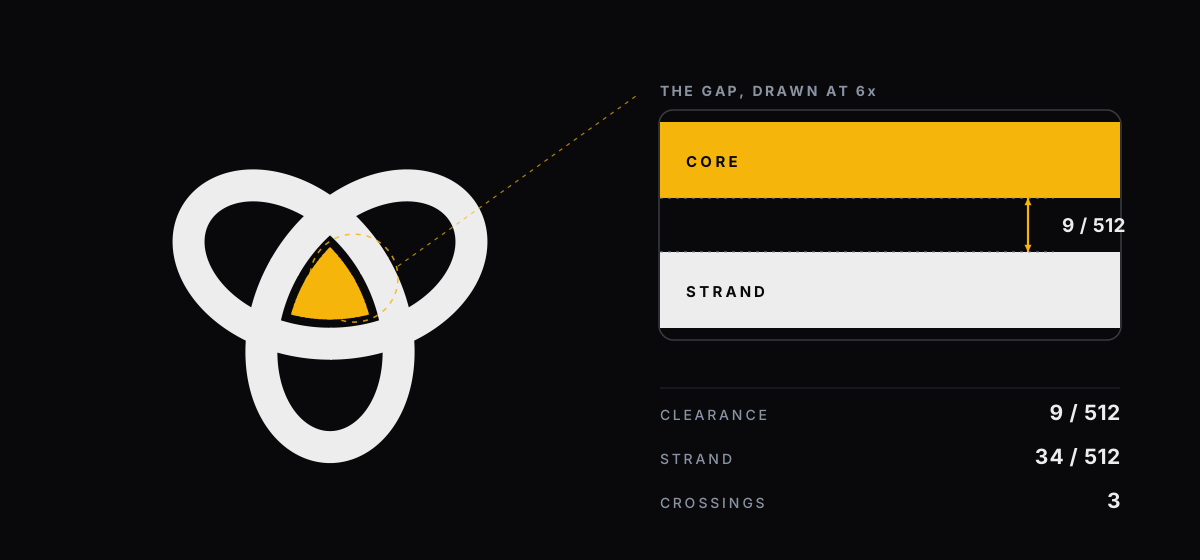
The strands are separated from the core by the same clearance that separates them where they cross: one value, measured against the drawing itself rather than chosen by eye. A gap you can see is a boundary you can audit. Everything we ship is governed the same way, by something that refuses to proceed when a rule is broken.
EvidenceHonesty, dependency, credential, theme and brand-claim checks run on every change. In the mark, the clearance is 9 of 512 units, identical at every boundary.
07
Interfaces
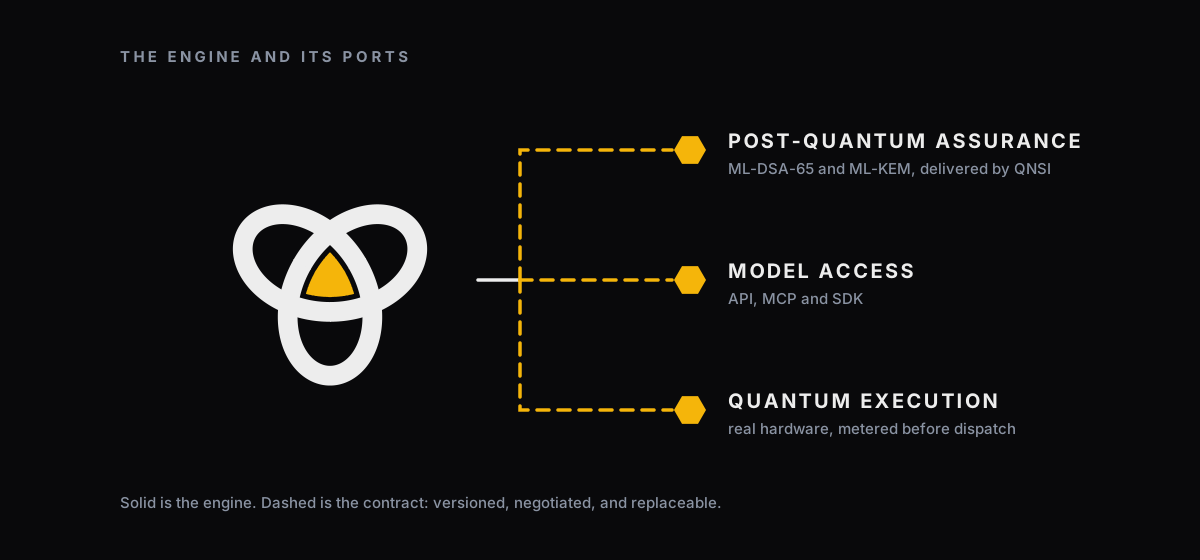
Solid is the core. Dashed is the contract.
Around the engine sits a set of dashed ports: post-quantum assurance, model access and quantum execution among them. They are dashed because they are versioned and negotiable. A new capability arrives as a new port, so the mark never has to change to admit it.
EvidenceOne monorepo with a single engine; provider fallbacks, protocol surfaces, API plans and deployment modes are all expressed as interfaces with terms.
08
Future
The mark encodes a law, not a roadmap.
Inventions will keep arriving, and some of them will invalidate parts of this stack. The drawing still holds: three strands, one clearance, one earned centre, and room for whatever plugs in next. A brand that must be redesigned every time the technology moves was never built to hold.
EvidenceThe mark is generated from parameters, not artwork. Strand weight, clearance and core are values, so the system can be re-rendered without being redrawn.

The law
01
White ships. Gold is earned.
02
The gap is background. Never paint it.
03
Attribute QNSI for cryptography and hardware.
04
Research is a strand, never a shelf.
05
A new capability is a new port.
Surface cuts
One geometry, four cuts. The white-on-transparent cut is for dark surfaces only: it has no contrast on light backgrounds, where the ink or single-colour cut is used instead.
Ink tile
App icons, favicons, store listings

White on transparent
Dark surfaces and social cards
Ink on transparent
Light surfaces and print

Single colour gold
Any surface, including print
Palette
Bee and the Bee knot logo are trademarks of HEOSSI (Pte.) Ltd., Singapore. Post-quantum cryptographic modules and quantum hardware access are delivered by QNSI, HEOSSI's quantum-native security platform. The gold centre denotes Bee Ignite, which is gated: it is drawn as an intention until its own production contract is satisfied. This page describes a mark, not a statement of shipped capability.